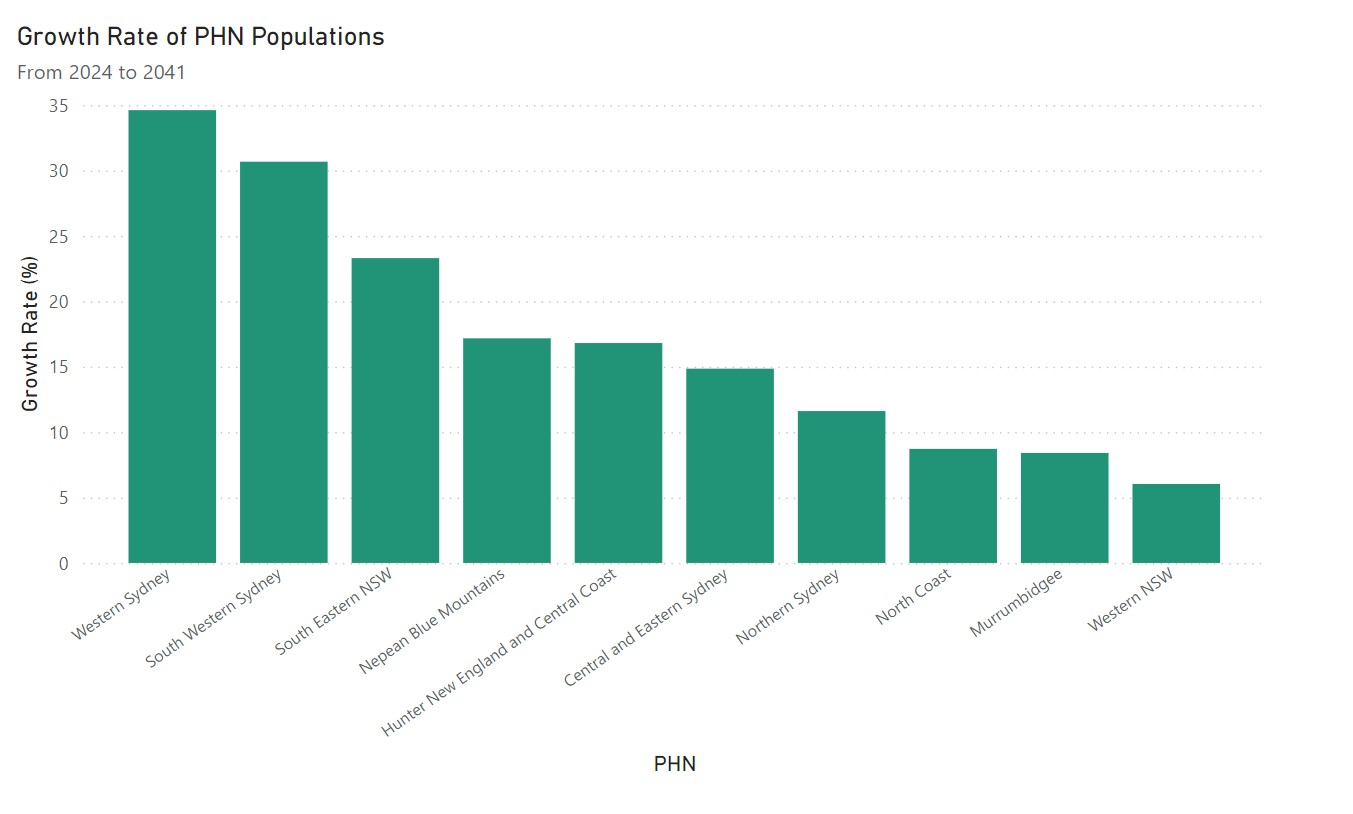
South Westen Sydney PHN (SWSPHN) is projected to experience substantial population growth of 30.67% between 2024 and 2041, making it the second-highest growing PHN after Western Sydney. The growth will be driven by significant increases in older age groups, paticularly those aged 75 and above, and will see a faster acceleration compared to the average growth rate of all New South Wales (NSW) PHNs combined, which is expected to slow down.
Between 2024 and 2041, SWSPHN is projected to experience substantial population growth, with an increase of 329,230 people. This positions SWSPHN as the second-highest growing PHN duing this period, trailing only Western Sydney PHN, which is expected to grow by 369,439 people. As seen in Figure 1, SWSPHN's growth represents a 30.67% increase, which, while significant, is slightly less than Western Sydney's 34.61%. This growth rate far exceeds the average growth rate for all NSW PHNs combined, which is projected at 19.36%.
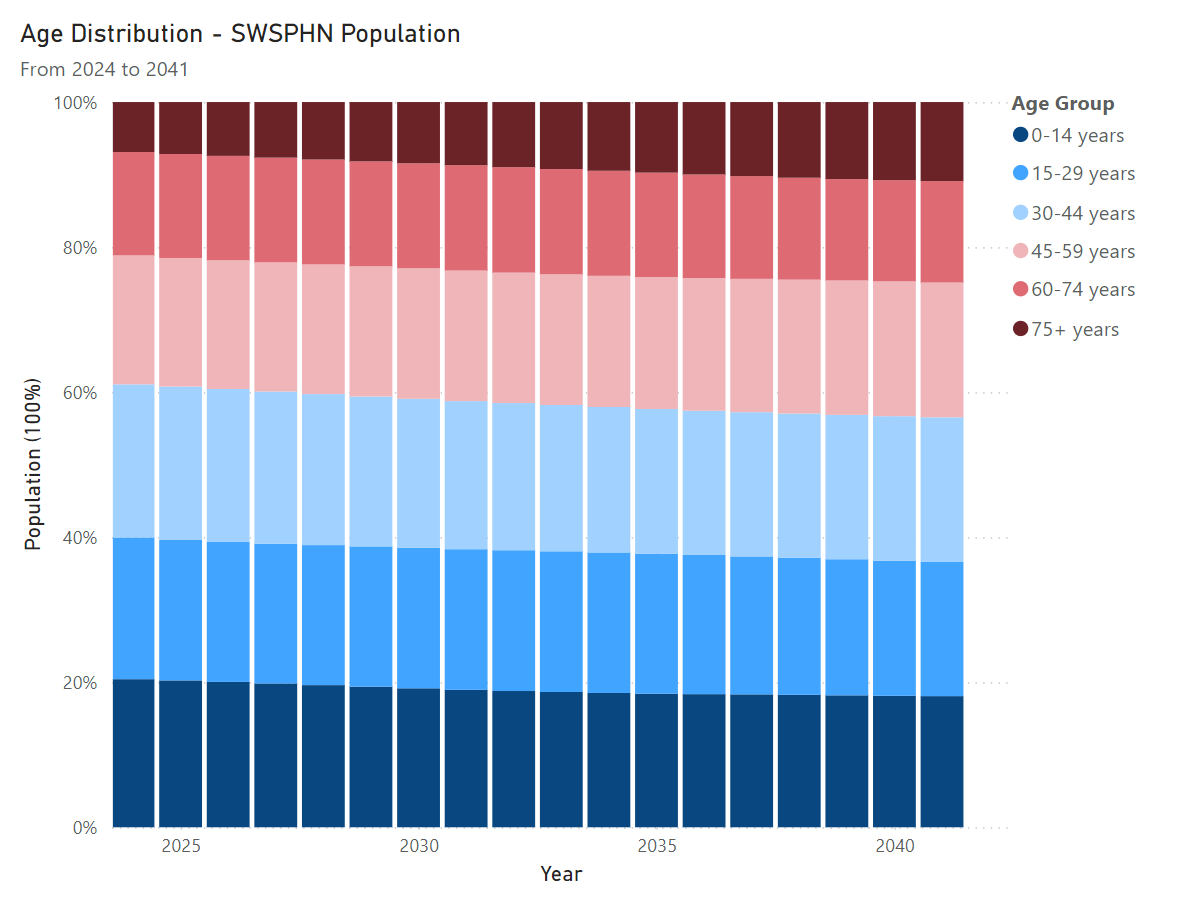
SWSPHN will undergo significant demographic shifts, paticularly among the older age groups, as visualised in Figure 2. The population of those aged over 85 years is expected to grow by 157.6%, and those aged 80-85 years will see a 121.6% increase. This indicates a marked ageing of the population within SWSPHN, as is similarly seen across all NSW PHNs. Within the 85+ years age bracket, Nepean leads with a 165.49% increase, while SWSPHN ranks second. SWSPHN, however, leads in growth for the 80-84 years group with a 121.6% increase, surpassing Nepean Blue Mountains, which is second with a 97.19% increase. Additionally, the population aged 75-79 years will grow by 66.01% in SWSPHN, the highest growth rate across all NSW PHNs. The 10-14 years age group will experience the smallest growth at 12.09%.
The growth rate of the female population in SWSPHN (31.47%) is projected to outpace that of the male population (29.86%). This trend of slightly higher growth rates for females compared to males is consistent across all NSW PHNs.
Looking ahead, SWSPHN's population growth rate is anticipated to accelerate over time, contrasting with the general trend observed across all NSW PHNs combined, where growth rates are slowing down. Specifically: